Chris Davis
Call Me YoursChris Davis is introduced as a lonely and physically burdened man whose apparent courtship with Kayla Morrison gradually becomes inseparable from the novel’s hidden account of Jamie Cooper’s dissociative identity disorder. He presents himself as Christopher Davis, a poor but diligent worker, a survivor of bereavement and chronic injury, and a man who believes that love can create a home after years of displacement. The later revelation that Chris exists within Jamie’s mind transforms the romance from a conventional correspondence plot into a tragic encounter between two people whose identities have been shaped by trauma, concealment, and forces outside their control.
Identity and Background
Chris’s first appearance places him in the Garden District of New Orleans doing physically demanding work. He struggles with a trash can filled with crumpled papers, a half-eaten sandwich, and chicken bones, while a cold wind makes him trip and sends pain through his back. The work is not merely a social marker of poverty: his aching shoulder blades, creaking bones, and throbbing back establish the body as a persistent material limitation. Even before his history is known, Chris is defined by labor that exhausts him and by a city in which he occupies a low, largely invisible position.
In his first letter to Kayla, he identifies himself as Christopher Davis, explaining that colleagues call him Chris. He says that he grew up in St. Francisville and moved to New Orleans at sixteen, a few months after his parents died in a car wreck. The move is therefore both geographical and biographical: New Orleans is the place where he must construct an adult life after losing the family that anchored his childhood. He describes the city as lively but lonely, while presenting his colleagues as kind people who have helped him adjust.
Chris also gives Kayla a carefully chosen portrait of his tastes and habits. He loves hot chocolate, watches the stars from the terrace of his apartment building, and listens to true-crime, mystery, and murder podcasts, especially those by Briton Brown. These details make him legible to Kayla as an individual rather than as a faceless laborer. They also become the basis of their imagined compatibility, since Kayla later says that she shares his love of hot chocolate and stargazing.
His physical history is more explicit in the exchange of letters. Chris tells Kayla that he lost his parents in the same car wreck at sixteen and that the accident left him with a back injury and a limp. He describes himself as five feet five inches tall, with brown hair and brown eyes, and says that he is clean-shaven. His statement that what matters is what is on the inside expresses both a romantic ideal and a defensive response to a body he expects may be judged. The novel thus gives his disability concrete effects—pain, impaired movement, limited social confidence, and restricted employment—rather than reducing it to a purely symbolic trait.
Work, Poverty, and the Search for a Home
Chris’s work at Morrison Hotel reveals the dignity he attaches to routine even when the institution offers him little status. He cleans an elegant conference room with silver chairs, a long glass table bearing the hotel’s logo, polished floors, corners, and windows. His pay is low, and he receives none of the bonuses, awards, or trips available to senior staff, yet he takes pride in making the room shine before an important meeting. Looking at his reflection in the window, he smiles and limps toward the next task. The scene places his impaired body inside a polished environment that promises luxury to others while assigning him invisible maintenance work.
Despite that inequality, Chris says that he loves the job because he has found a home there. His hope is not material advancement but belonging: he imagines that he will soon have a real home with Kayla, whom he calls the love of his life. This aspiration connects employment, romance, and domestic security. The hotel is temporarily the closest thing he has to stability, while Kayla becomes the imagined future in which stability will finally become personal and permanent.
Later, while speaking with Dr. Reid Francois, Chris recounts a harsher period before he secured an apartment. He slept on the street for days and sometimes woke in places he could not remember reaching, including the bathroom of a five-star hotel. He recognized that something was wrong but had no friends or family to consult. Barely surviving and without a home, he found work as a dishwasher in a restaurant, where kind chefs gave him leftovers and allowed him to take home food that could not be served. By saving money, he eventually obtained an apartment. The account casts his later pride in hotel work as the achievement of someone who has repeatedly had to assemble shelter and identity from scraps.
The Letter Romance with Kayla Morrison
Chris’s relationship with Kayla begins through correspondence after Kayla’s newspaper matchmaking advertisement. He becomes intensely absorbed in her letters, preparing lists of things he wants to tell her and interpreting a burgundy lipstick mark on one envelope as proof that he is special to her. He understands the mark as an intimacy no woman has previously offered him and as evidence that someone has stayed long enough to approach him emotionally. The letter is therefore not just communication; it becomes a material token that converts loneliness into apparent reciprocity.
Kayla’s reply confirms the intensity of the connection. She says that she feels in her gut that they are meant to be together, that the universe has handpicked them for one another, and that their shared love of hot chocolate and stargazing makes the relationship feel destined. She also tells Chris that his appearance does not matter to her and that the connection between them is what counts. Her language reinforces his belief that inward character can overcome social difference, physical limitation, and the divide between Kayla’s wealth and his poverty.
Chris answers with equal emotional force. He tells Kayla that he understands pain and loneliness, describes his parents’ death and his resulting back injury and limp, and asks about her daughter. He says that he has always wanted a daughter but never found the right person with whom to start a family. His questions about Adi Morrison are not incidental: they show him imagining not merely a romance with Kayla but entry into a family. The correspondence gives him a future-oriented identity—as partner, husband, and father—that his earlier life of bereavement, homelessness, and failed first dates had denied him.
When Chris discovers that he works for Kayla, the romance acquires a dangerous asymmetry. He is one of her employees, a janitor who may never have crossed her path because his labor keeps him behind the scenes. In an email, he tells her that he does not care about her money, that he loves Kayla Renae Morrison, and that he would like to marry her and have a family with her if she will accept him. He ends with the appeal “Call me yours,” making possession, belonging, and romantic recognition converge in a single phrase. His declaration is sincere within the identity he inhabits, but the later revelations make its certainty tragic: the person writing as Chris cannot possess an independent life separate from Jamie’s fractured mind.
Revelation, Control, and the Alter Identity
Chris’s apparent independence is challenged when Jessica Cooper explains that her husband Jamie has DID and that Chris is one of Jamie’s alters. Kayla first hears that “Davis” is being discussed and realizes that the name refers to Chris Davis. Jessica confirms it, although Kayla rejects the explanation as a lie. The disclosure reverses Kayla’s understanding of the correspondence, the workplace relationship, and the man she believed she loved. Chris is no longer simply a disadvantaged suitor hiding his social position; he is an identity generated within another person’s traumatic psychological structure.
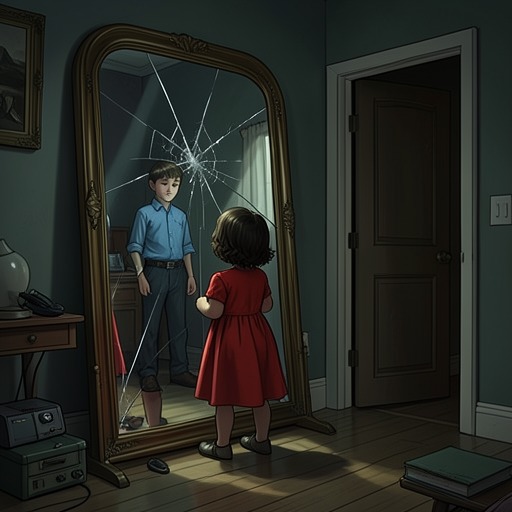
The revelation becomes experiential rather than merely verbal when Dr. Francois asks to speak with Chris. After Kayla is placed under hypnosis, her features change, she tears off her blond wig, twists in apparent pain, and then sits up with a hunched back, rubbing her neck and lower back. Dr. Francois addresses the transformed person as Chris. The scene links Chris’s physical presentation to the body shared with Kayla and the other alters, while also showing that his appearance can be externally induced through treatment. Identity is presented as embodied but unstable, emerging through changes in posture, voice, clothing, and control of the body.
Jessica tells Chris that Kayla does exist, but only in her husband’s head, and Chris then understands that he too is an alter, alongside others. This exchange destroys his assumption that the romance existed between two autonomous people in an ordinary world. Yet the emotional reality of the relationship is not erased by its psychological origin. Chris’s love, memories, labor, and hopes remain meaningful to him even as the narrative denies him an independent biological existence.
Don’s account supplies the history behind Chris’s formation and vulnerability. Don says that he wanted to help Jamie but returned too late: Christin and Davis had already broken Jamie’s mind, body, and soul and placed him under their control. Jamie became their puppet and was made to do terrible things; in Don’s words, he was no longer Jamie but Chris Davis, the “son” of Christin and Davis. Chris is therefore connected to coercive conditioning and criminal manipulation. He is not presented simply as a false identity invented for deception; he is also the result of a person’s destruction by abusers who imposed a new role upon him.
Love, Sacrifice, and Ending
Chris’s final movement is away from claiming a future and toward protecting Jamie. During treatment, he says that he does not want to live anymore and asks Dr. Francois to do whatever it takes to help Jamie. The statement marks a decisive change in his objective. Earlier, he wanted a home, a marriage, and a daughter with Kayla; now he treats the survival and recovery of the underlying person as more important than preserving himself as an alter.
When Dr. Francois offers Kayla the chance to speak to him, Chris tells her that he loves her and mourns the life they had imagined: a shared home, a beautiful daughter, and a love story in which she could call him hers for the rest of her life. Kayla forgives him and says that she is ready. Chris holds her hands, tells her that he loves her, and says, “Let’s go, my love.” Jamie then slumps on the bed until Don takes over the body, and Don immediately protests that he will not be eliminated easily and demands the vodka he was promised. The abrupt succession from Chris’s farewell to Don’s defiance emphasizes that Chris’s disappearance is not the end of the disorder within Jamie, but one stage in the struggle to recover Jamie from the alters and the people who controlled him.
Chris’s ending is consequently both romantic and tragic. He never receives the ordinary domestic future promised by the letters, and his relationship with Kayla cannot become a conventional marriage. Nevertheless, his final act gives his love an ethical direction: he relinquishes the life he wanted so that Jamie may have a chance to live. The character’s significance lies in this contradiction. Chris is created through violence and sustained by longing, appears as a poor disabled worker seeking recognition, becomes the beloved figure of an intense epistolary romance, and finally accepts self-erasure as an act of care. His story insists that an identity can be psychologically constructed and still carry genuine emotional consequences, while also showing how poverty, bodily impairment, homelessness, and loneliness make the promise of belonging especially powerful.